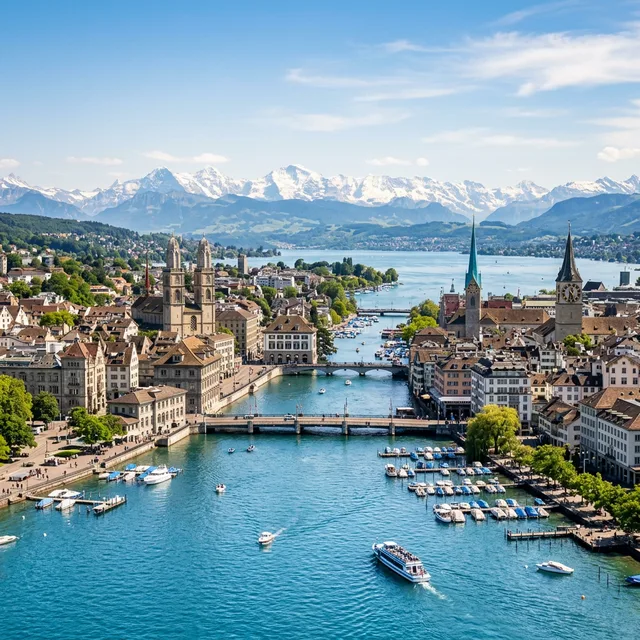

🏰 Medieval Old Town & Historic Heritage
Zurich’s historic core represents centuries of Swiss heritage and architectural beauty.
- Grossmünster Cathedral: Zurich’s iconic Romanesque cathedral with twin towers was where Huldrych Zwingli launched the Swiss Protestant Reformation in 1519, making it one of the most historically significant churches in European Protestantism. The towers (each climbable) dominate the Old Town skyline and offer good views over the Limmat River and Lake Zurich. The interior is deliberately austere — Zwingli stripped all ornamentation from the church — but the modern stained glass windows by Sigmar Polke (installed 2009) in the baptistery are masterworks of contemporary religious art.
- Fraumünster Church: This Gothic church across the river from Grossmünster is famous for its five choir windows designed by Marc Chagall in 1970 and a rose window by Augusto Giacometti from 1945. The Chagall windows — depicting biblical scenes in vivid blues, greens, and reds — are considered among the finest examples of 20th-century stained glass in Europe. The church is best visited in morning light when the colors are most intense. Entry costs CHF 5; crowded in summer, peaceful in early morning.
- Niederdorf District (Old Town): The east bank Old Town district — known as Niederdorf or colloquially as “Dörfli” — is Zurich’s most atmospheric neighborhood for wandering: narrow medieval lanes, guild houses with painted facades, independent bookshops, wine bars, and small restaurants. The architecture spans Romanesque through Renaissance; many buildings are identified with numbered plaques. The Niederdorf comes alive in the evenings when the bars fill with a mix of locals and visitors.
- Zurich Town Hall (Rathaus): Beautiful Renaissance building on the Limmat River, representing Zurich’s civic architecture and governmental history, featuring ornate facades and historical significance. The building represents Zurich’s municipal heritage. The architecture is Renaissance. The location is picturesque. The building houses government functions.
- Kronenhalle Restaurant: This legendary Zurich restaurant has operated continuously since 1924 and is lined with an extraordinary collection of original works by Picasso, Chagall, Miró, Giacometti, and Matisse — gifts and purchases accumulated over decades of patronage by the city’s artistic and intellectual elite. The restaurant serves traditional Swiss-French cuisine in a belle époque setting; the experience is expensive but historically unique. Reservations are essential.
🏦 Financial District & Modern Zurich
Zurich’s business district showcases Swiss precision and modern architecture.
- Bahnhofstrasse: Consistently rated among the world’s most expensive retail streets, the 1.4-km boulevard from the main railway station to Lake Zurich passes the headquarters of UBS and Credit Suisse, luxury boutiques (Cartier, Patek Philippe, Rolex), and the famous Sprüngli confectionery, which has been making Luxemburgerli macarons here since 1859. The street’s tram lines run down the center; the underground Shopville mall beneath the station provides a budget-friendly counterpoint.
- Prime Tower: Zurich’s tallest building at 126 meters, completed in 2011 in the former industrial district of Zürich West, is architecturally refined by Swiss standards — a faceted glass tower that changes color with the light. The surrounding Zürich West neighborhood was transformed from factories and rail yards into galleries, restaurants, and the Schiffbau cultural center (theater and jazz club in a massive 1890s shipbuilding hall). The area around the Prime Tower, Puls 5 market hall, and Frau Gerolds Garten is the best example of Zurich’s post-industrial creativity.
- Swiss National Museum: Castle-like museum chronicling Swiss history, representing Zurich’s cultural preservation and national heritage, featuring extensive exhibits from prehistoric times to modern Switzerland. The museum’s permanent collection covers 6,000 years of Swiss history and the applied arts — medieval altarpieces, guild silverware, Reformation-era documents, and a full-scale reconstruction of a 16th-century armory. Entry is free on the last Saturday of each month. The 2016 extension by Christ & Gantenbein architects connects seamlessly to the historic building.
- Urania Observatory: Historic astronomical observatory with planetarium, representing Zurich’s scientific heritage and astronomical tradition, offering stargazing and educational exhibits. The observatory represents Zurich’s scientific culture. The building is historic. The planetarium is modern. The views are educational.
- Zürich HB (Main Station): Switzerland’s busiest railway station — handling around 480,000 travelers daily — is an architectural marvel of 19th-century ambition, with a vast arched main hall dating from 1871. The station’s underground levels contain extensive shopping; the Hauptbahnhof Christmas Market, held under the main hall roof each December, is one of Switzerland’s largest and most atmospheric. The station’s punctuality record is a point of national pride.
🎨 World-Class Museums & Culture
Zurich’s museums showcase Swiss and international art and culture.
- Kunsthaus Zürich: Significantly expanded in 2021 with a new building designed by David Chipperfield Architects, the Kunsthaus is now the largest art museum in Switzerland. The collection of 4,500 paintings and sculptures spans from medieval masters to the present — strong on Swiss artists (Hodler, Giacometti), German Expressionists, and French Impressionists. The Chipperfield extension houses the exceptional Bührle Collection of Impressionist and Post-Impressionist works (Monet, Renoir, Van Gogh, Cézanne). Book tickets online; the museum is closed Mondays.
- FIFA World Football Museum: Interactive museum dedicated to football history, representing Zurich’s global sports significance and FIFA’s presence, featuring engaging exhibits and memorabilia. The museum represents football heritage. The exhibits are interactive. The collection is comprehensive. The museum appeals to sports fans.
- Museum Rietberg: Museum of non-European art in a beautiful villa, representing Zurich’s international cultural interests and artistic diversity, featuring Asian, African, and American art. The museum represents global art. The villa is beautiful. The collection is diverse. The setting is peaceful.
- Centre Le Corbusier (Heidi Weber Museum): The only building Le Corbusier designed as a museum — a steel-and-glass structure completed posthumously in 1967, the year after his death — houses a collection of his paintings, sculptures, tapestries, and architectural models. The building is a working demonstration of his Five Points of Architecture and Modulor proportional system. It stands on the lakeside in Zürichhorn Park, a perfect setting for a small but architecturally significant collection.
- Vitamin D Foundation: Contemporary art foundation in industrial spaces, representing Zurich’s modern art scene and creative innovation, featuring cutting-edge contemporary exhibitions. The foundation represents Zurich’s contemporary culture. The spaces are industrial. The art is cutting-edge. The foundation supports artists.
🏔️ Lake Zurich & Nature
Zurich’s lake offers recreational opportunities and scenic beauty.
- Lake Zurich (Zürichsee): The 40-km lake stretching southeast from the city is one of Switzerland’s most beautiful and most swimmable — Zurich’s outdoor pool culture (Badi culture) centers on the lake, with dozens of public lakeside bathing areas open from May to September. The most famous is the Frauenbadi (women only during the day, mixed in the evening) and the Seebad Enge. In summer, locals swim directly in the lake from city-center docks. Boat trips along the lake to Rapperswil (1.5 hours) give the best perspective of the Alps rising beyond the Swiss plateau.
- Uetliberg: At 871 meters, Uetliberg is Zurich’s local mountain — reached by a direct train (S10) from Zürich HB in 22 minutes. The summit offers sweeping views over the city, the lake, and on clear days the entire Alpine chain from the Säntis to the Bernese Oberland. A marked trail (the Planetenweg/Planet Walk) runs along the ridge to Felsenegg, from where a gondola descends to Adliswil. The walk takes about 1.5 hours and is accessible year-round.
- Zürichhorn Park: Beautiful lakeside park with gardens and sculptures, representing Zurich’s green spaces and recreational areas, featuring Chinese Garden and Kongresshaus. The park represents Zurich’s green heritage. The gardens are beautiful. The sculptures are artistic. The area offers relaxation.
- Botanical Garden (Botanischer Garten): Extensive botanical gardens with diverse plant collections, representing Zurich’s horticultural heritage and scientific interest, featuring greenhouses and outdoor exhibits. The garden represents Zurich’s plant diversity. The greenhouses are impressive. The collection is extensive. The garden offers education.
- Arboretum: Tree collection showcasing global species, representing Zurich’s environmental awareness and botanical diversity, featuring labeled trees from around the world. The arboretum represents global trees. The collection is educational. The setting is peaceful. The trees are diverse.
🍫 Swiss Chocolate & Local Specialties
Zurich’s culinary scene reflects Swiss traditions and chocolate heritage.
- Lindt Home of Chocolate: The Lindt chocolate factory and museum in Kilchberg, 8 km from central Zurich by lake steamer or bus, opened in 2020 and has become one of the most visited attractions in the Zurich area. The 1,500-square-meter exhibition traces chocolate history from the Mayans to modern Swiss production. The centerpiece is a 9-meter-tall chocolate fountain — the world’s largest. The factory shop sells Lindt products at reduced prices; the café offers chocolate tastings.
- Swiss Chocolate Culture: Zurich’s Old Town has several historic chocolatiers worth seeking out beyond the major chains. Confiserie Sprüngli at Paradeplatz (founded 1836) is the most celebrated — their Luxemburgerli (small macarons), fresh truffles, and pralines are standards by which Swiss confectionery is judged. The shop’s first floor tearoom serves breakfast and afternoon tea in a classic Swiss-bourgeois atmosphere.
- Zürcher Geschnetzeltes: Zurich’s signature dish — thin strips of veal sautéed with onions and mushrooms in a white wine and cream sauce, served on a bed of rösti potatoes — appears on virtually every traditional restaurant menu. The dish requires high-quality veal (Zurich chefs are particular about this) and precise timing to keep the meat tender. The best versions are found at traditional restaurants like Kronenhalle, Haus zum Rüden, and the Zunfthaus zur Zimmerleuten (a medieval guild house).
- Rösti: This crispy potato cake — grated potato formed into a round and fried in butter until golden — is Switzerland’s most beloved side dish and represents a culinary divide between German-speaking and French-speaking Switzerland (the “Röstigraben” or “rösti barrier”). In Zurich it comes plain or with cheese, bacon, or eggs. The best rösti has a thin crispy exterior and a creamy interior; it should be made from cold, pre-cooked potatoes rather than raw.
- Fondue Tradition: Swiss cheese fondue experience, representing Zurich’s social dining culture and culinary heritage, featuring communal dining and local wines. The tradition represents Swiss socializing. The cheese is melted. The bread is dipped. The experience is communal.
- Modern Swiss Cuisine: Zurich’s contemporary restaurants featuring local ingredients, representing Swiss culinary innovation and gastronomic excellence, blending tradition with modernity. The cuisine represents Swiss evolution. The ingredients are local. The cooking is innovative. The dining is sophisticated.
🚇 Practical Zurich Guide
- Best Time to Visit: May-September for mild weather and outdoor activities, or December-February for winter sports and holiday markets. Zurich offers four distinct seasons. Summer is pleasant. Winter brings snow nearby. The city is beautiful year-round.
- Getting Around: Excellent public transport with trams, buses, and trains. The city is walkable in central areas. The system is punctual and clean. Taxis are available but expensive. The network is comprehensive.
- Museum Planning: Kunsthaus and other major museums often have free admission. Book FIFA Museum tickets online. The museums are spread throughout the city. Audio guides are available. The museums offer education.
- Safety & Etiquette: Extremely safe with low crime rates. Zurich is orderly and clean. Swiss value punctuality and respect. The city is peaceful and polite. Public behavior is restrained.
- Cost Considerations: Expensive compared to other European cities. Budget €150-300 per day. Public transport is affordable. Many museums are free. Local dining can be costly. The city offers quality experiences.
- Cultural Notes: Zurich represents Swiss precision and quality. The city embodies Swiss values. Zurich is multicultural yet orderly. The people are reserved but welcoming. Zurich showcases Swiss excellence.
- Language: German is primary (Swiss German dialect), but English widely spoken. Zurich is multilingual. French and Italian also official. The German is distinct. Communication is easy.
- Time Zone: Central European Time (CET), UTC+1. Daylight Savings Time observed (CEST, UTC+2).


