
Chengdu Travel Guide 2026: Pandas, Spice & Tea
There is an old Chinese saying: “Once you come to Chengdu, you do not want to leave.” While Beijing is about power and Shanghai is about money, Chengdu is about lifestyle. It is the most laid-back mega-city in China, a place where people spend hours sipping tea in parks, playing Mahjong, and eating some of the most complex, flavorful food on the planet. And, of course, it is the only major city in the world where Giant Pandas live in the wild just outside the city limits.
Expert Insight: Don’t just go to the main Panda Base. If you have time (and a driver), go to the Dujiangyan Panda Base (1.5 hours away). It is less crowded, more mountainous, and offers volunteer programs where you can clean enclosures and prepare bamboo (booking months in advance required).
The Panda Capital
This is the main reason millions come here, and it does not disappoint.
-
Chengdu Research Base of Giant Panda Breeding: The most accessible site, just 10km from downtown. It houses over 100 pandas. The “Sunshine Nursery House” and “Moonlight Nursery House” are where you can see baby pandas in incubators (usually born in August/September).
-
Red Pandas: Often overlooked but equally adorable. They roam freely in certain parts of the base and will run right across the path in front of you.
UNESCO City of Gastronomy
Chengdu was the first city in Asia to be designated a UNESCO City of Gastronomy.
-
Hot Pot: A religion here. You cook raw meats and vegetables in a bubbling vat of chili oil and peppers. Try Xiao Long Kan or Shu Jiu Xiang for authentic experiences.
-
Mapo Tofu: This famous dish was invented here. Visit Chen Mapo Tofu, the restaurant that claims to be the original creator in 1862. It is far spicier and more numbing than any version you’ve had abroad.
-
Street Snacks: Try “Dan Dan Noodles,” “Zhong Dumplings,” and “Rabbit Heads” (yes, really—it’s a local delicacy, spicy and savory).
Teahouse Culture
To understand Chengdu, you must waste time in a teahouse.
-
People’s Park (Renmin Park): The heart of the city. At the Heming Teahouse, establish in 1923, you can sit in bamboo chairs by the lake, sip jasmine tea from a gaiwan, and get your ears cleaned by professional ear-pickers (a strange but strangely relaxing local tradition).
-
Mahjong: You will hear the clacking of tiles everywhere. It is the sound of the city. Locals play anywhere—in parks, in rivers (tables set up in the shallow water during summer), and even inside caves.
Modern Chengdu
It’s not just old traditions; Chengdu is a sci-fi city of the future.
-
Taikoo Li & IFS: A stunning open-air shopping district built around the ancient Daci Temple. Look up to see the giant climbing panda sculpture on the side of the IFS building.
-
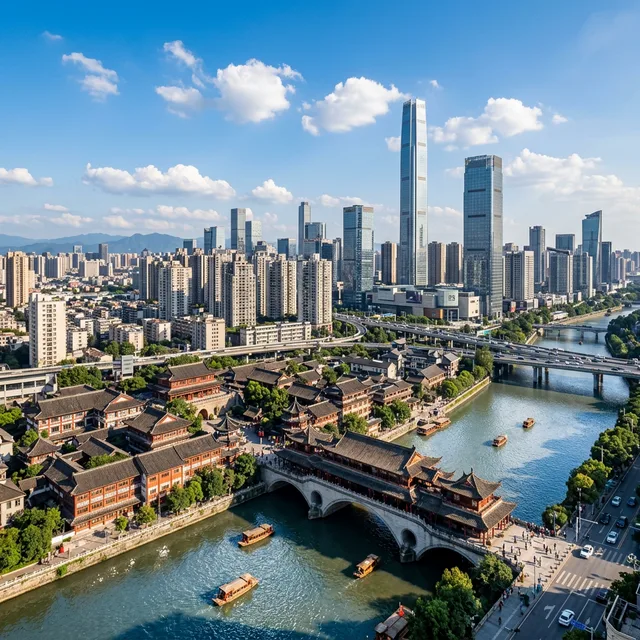
Anshun Bridge: A reconstructed bridge spanning the Jinjiang River. At night, it lights up beautifully and is home to the most expensive restaurant in the city. The bar street along the riverbank comes alive after 10 PM.
Practical Chengdu Guide
-
Getting There: Chengdu Tianfu International Airport (TFU) is massive and new. It is connected to the city by a high-speed metro (Line 18).
-
Language: The local dialect (Sichuanese) is quite different from standard Mandarin, but most young people speak Mandarin. English signage is good in the metro but limited elsewhere. Download a translation app (Baidu Translate or a VPN-enabled Google Translate).
-
Internet: The “Great Firewall” blocks Google, Facebook, Instagram, WhatsApp, and YouTube. You must install a reliable VPN before you enter China, or use a roaming eSIM (which bypasses the firewall automatically).
-
Navigation: Google Maps is outdated and inaccurate in China. Use Apple Maps (works well) or download Gaode Maps (Amap) if you can navigate the Chinese interface.
🏯 Cultural & Historical Sites
Beyond the pandas, Chengdu has a remarkable depth of history rooted in the ancient kingdom of Shu:
- Wuhou Shrine (Wuhou Ci): A temple complex dedicated to Zhuge Liang, the legendary military strategist of the Three Kingdoms period (220–280 AD), and Liu Bei, the ruler of Shu Han. The complex includes beautiful courtyards, ancient ginkgo trees, and an atmospheric museum that brings one of China’s most-loved historical periods to life. Adjacent to the Jinli Old Street night market.
- Jinsha Site Museum: A remarkable archaeological museum built directly over an excavation site where the remains of the ancient Sanxingdui culture were unearthed. The gold sun disk found here — a 3,000-year-old artifact — is now the emblem of Chengdu. The museum’s combination of active excavation and display is unique in China.
- Du Fu Thatched Cottage: A memorial park dedicated to the Tang Dynasty poet Du Fu (712–770 AD), considered one of the greatest poets in Chinese literary history. He spent several years in Chengdu during a period of political exile, writing over 240 poems here. The park’s bamboo groves and classical garden design create a genuinely peaceful retreat from the city.
- Jinli Old Street: A commercial reconstruction of a Han Dynasty-era street, which sounds gimmicky but is genuinely fun at night. The red lanterns, traditional architecture, and street food vendors create a festive atmosphere. Try the dumplings, sugar painting (a folk art using caramelized sugar), and Dragon Beard candy made to order.
🌄 Day Trips from Chengdu
Chengdu’s position in Sichuan province puts it within reach of some of China’s most extraordinary landscapes:
- Leshan Giant Buddha: A 71-meter stone Buddha carved into a cliff at the confluence of three rivers, the largest stone Buddha in the world and a UNESCO World Heritage Site. Built over 90 years during the Tang Dynasty, the scale is genuinely awe-inspiring when seen from the water — take the boat cruise for the best perspective. About 2.5 hours by bus or high-speed train.
- Mount Emei (Emeishan): One of China’s four sacred Buddhist mountains, 3,099 meters high and covered in ancient temples and dense forest. Cable cars take you close to the snow-capped summit, where the Golden Summit Temple offers sunrise views above the clouds. The mountain is home to large and surprisingly bold Tibetan macaque monkeys — do not bring food or make eye contact.
- Jiuzhaigou Valley: One of the most visually extraordinary landscapes in China — a series of glacial lakes in impossible shades of turquoise, teal, and cobalt blue, separated by forested ridges and dramatic waterfalls. About 5 hours north of Chengdu by bus or a short flight. Requires advance booking as visitor numbers are strictly limited to protect the UNESCO-listed ecosystem.
- Sanxingdui Museum: Near Guanghan, 40 km north of Chengdu, this museum houses one of the most mysterious and remarkable archaeological finds of the 20th century — the artifacts of a Bronze Age civilization that vanished without a written record, producing otherworldly gold masks and bronze figures that look unlike anything else in Chinese art history.
🍜 Sichuan Food: Going Deeper
No city in China takes its food culture as seriously as Chengdu. Understanding the cuisine takes more than a single meal:
- The “Má” and “Là” Principle: Sichuan cooking is built around two sensations — Má (the numbing tingle from Sichuan peppercorns) and Là (the heat of chili). Good Sichuan food balances these two sensations rather than simply making everything aggressively spicy. The numbing effect of the peppercorns is unique to this cuisine and genuinely unlike anything in other spice traditions.
- Sichuan Peppercorn Shopping: Buy fresh Sichuan peppercorns at Chengdu’s markets to bring home — they lose their potency quickly when old, which is why the versions sold abroad rarely taste the same. The Qingyang Palace area has excellent spice markets.
- Cooking Classes: Several schools in Chengdu offer hands-on Sichuan cooking classes in English. The Sichuan Higher Institute of Cuisine is the most prestigious; private operators in the Jinli area offer shorter, more tourist-friendly sessions focusing on mapo tofu and dumplings.
❓ FAQ: Visiting Chengdu
How early should I go to the Panda Base? Arrive when the gates open (7:30am). Pandas are most active in the morning when they’re being fed. By 10am the crowds have grown substantially and the pandas often nap for most of the day. The main Chengdu Research Base is busy even on weekday mornings — the Dujiangyan base is significantly quieter.
Do I need a VPN in Chengdu? Yes, if you want to use Google, Instagram, WhatsApp, or any Google-based service. Download and set up a reliable VPN on all your devices before you enter China — once inside, it can be difficult to download VPN apps from the App Store due to regional restrictions. A roaming eSIM from your home country can also bypass the firewall automatically.